Funded by the European Union – NRRP
Component 9 – Support for the private sector, research, development and innovation
Investment 8 – “Development of a programme for attracting highly specialised human resources from abroad to research, development and innovation activities”
PNRR/2022/C9/MCID/I8
 
Project title:Novel Graphene/metal composites as advanced catalytic systems in the hydrogen based energetics(Innovative graphene/metal composites as advanced catalytic systems for hydrogen-based energy applications)
 
Beneficiary: National University of Science and Technology POLITEHNICA Bucharest
 

SCIENTIFIC RESULTS

The project focused on the development of new catalytic systems applicable to electrochemical processes in energy systems, namely electrochemical hydrogen production and polymer-electrolyte fuel cells. An essential practical objective was the total or partial replacement of expensive noble metals with more affordable alternatives. The new catalytic systems are based on transition metals attached to carbon matrices, such as reduced graphene oxide (rGO). Ni, Co and Cu were investigated, together with combinations of these metals and combinations with Pd and Pt in amounts below 3%.

The novelty of the proposed concept and strategy lies in the unique structure and morphology of the proposed catalytic systems. Simple and efficient synthesis protocols were optimised and applied to produce a wide range of metallic species on the rGO surface.

The implementation of the project also contributed to advancing knowledge in this field at UPB-CSSNT.

As a result of the experimental activities, the project developed:
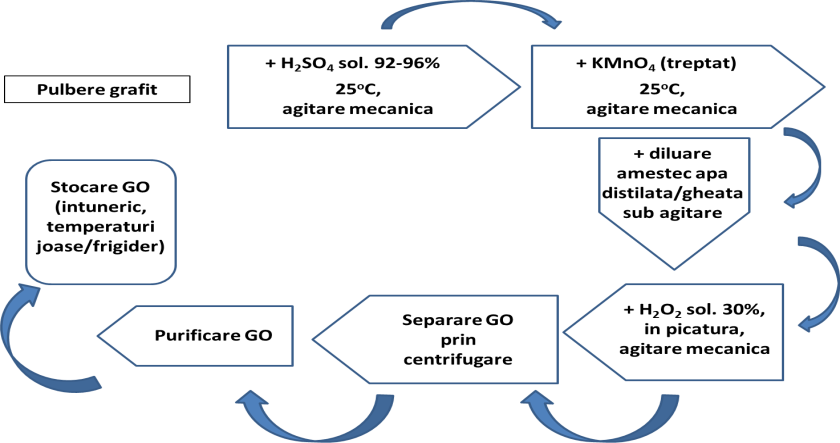
  • A procedure for the synthesis and characterisation of graphene oxide (GO), used as a precursor for M/rGO and M1M2/rGO composites, where M, M1 and M2 represent transition-metal species.
Stages of the GO synthesis process
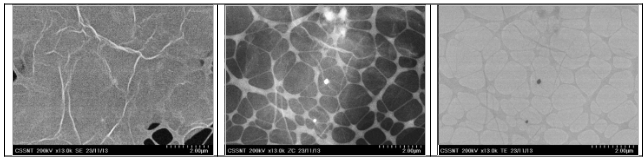
STEM micrographs of GO recorded simultaneously using three techniques: SEM (left), atomic-number contrast – ZC (centre), and TEM (right), at the same location on the sample.
  • Synthesis protocols for M/GO compounds (M = Co, Pd, Cu, Pt, Au) and M1M2/GO compounds (M1 = Co, Cu; M2 = Pd, Pt), which subsequently yield M/rGO and M1M2/rGO composites through reduction processes.
  • Protocols for the synthesis and physicochemical and electrochemical characterisation of M/rGO and M1M2/rGO composites.
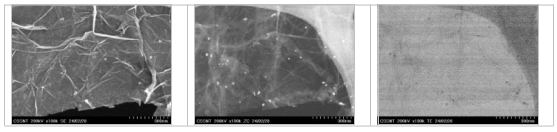
STEM micrographs of the synthesised Co/rGO composite, recorded using SE – secondary-electron (left), ZC – phase-contrast (centre), and TE – transmitted-electron (right) detectors, at the same location on the sample.
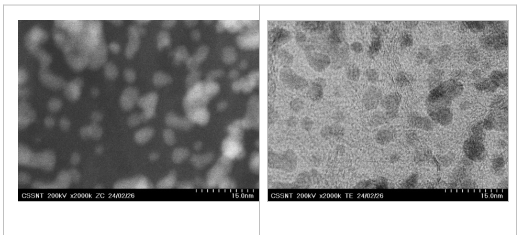
STEM micrographs of the synthesised Co-Pd/rGO composite, recorded using ZC – phase-contrast (left) and TE – transmitted-electron (right) detectors, at the same location on the sample.
  • Protocols for the synthesis and physicochemical and electrochemical characterisation of composites using carbon black (CB) as a substrate, including Co-Pt/CB and Cu-Pt/CB systems.
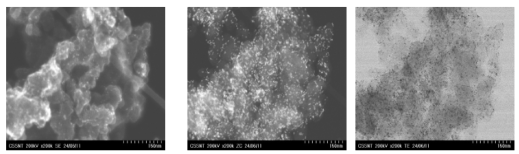
STEM micrographs of the synthesised Cu-Pt/CB composite, recorded using SE – secondary-electron (left), ZC – phase-contrast (centre), and TE – transmitted-electron (right) detectors, at the same location on the sample.
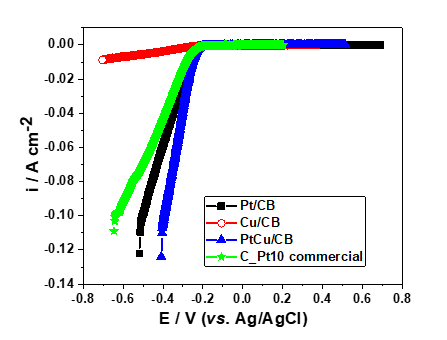
Comparative cathodic linear-polarisation curves for the hydrogen evolution reaction in 0.5 M H2SO4, using electrodes modified with CB/Cu-Pt and C_Pt10 commercial catalyst, at 10 mV/s.
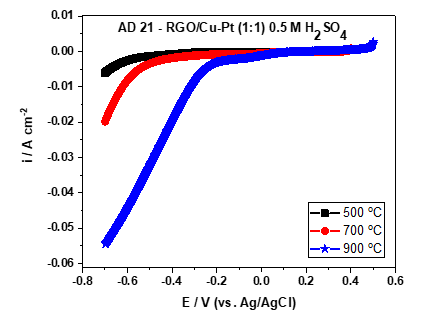
  • Synthesis protocols for obtaining RGO/M1M2 bimetallic hybrid composites, in which M1M2 represents binary nanoparticles (M1 = Co, Cu; M2 = Pt), together with their characterisation and an assessment of the influence of heat-treatment temperature on morphology and electrochemical activity. Heat treatments at 700–900 °C promote a more efficient electrocatalytic effect.
Potentiodynamic cathodic-polarisation curves in 0.5 M H2SO4 for RGO/Cu-Pt composites with a Cu:Pt ratio of 1:1 in solution, subjected to different heat-treatment conditions, at 10 mV/s and 25 degrees Celsius.
Potentiodynamic cathodic-polarisation curves in 0.5 M H2SO4 for RGO/Cu-Pt composites with a Cu:Pt ratio of 1:1 in solution, subjected to different heat-treatment conditions (10 mV/s, 25 °C).
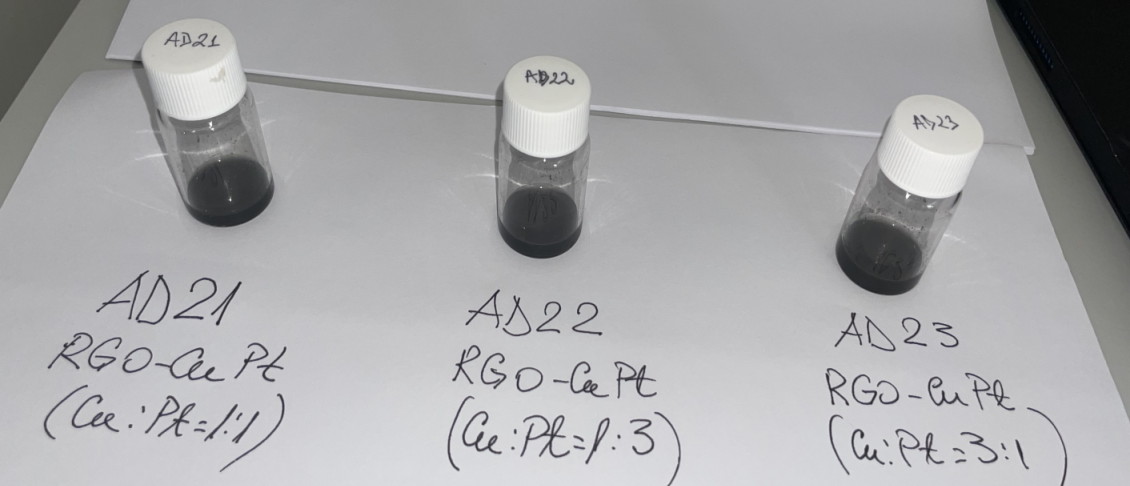
Photograph of optimised RGO/Cu-Pt composites in suspension form, suitable for application to the working electrode.
  • Optimisation of the deposition protocols for the synthesised catalysts, including quantity, sequence and method, on the gas-diffusion layer (GDL) of the membrane-electrode assembly (MEA), for PEM fuel-cell applications.
  • A laboratory-scale experimental electrolyser model for hydrogen production, using the synthesised electrocatalysts as cathode materials. Porous Ni electrodes obtained by electrodeposition on a metallic Cu substrate were used, and electrocatalyst suspensions were deposited on them to form the cathode.
  • An experimental PEM fuel-cell model with a membrane-electrode assembly (MEA) constructed using the synthesised electrocatalysts selected on the basis of rotating-disc electrode (RDE) experiments.
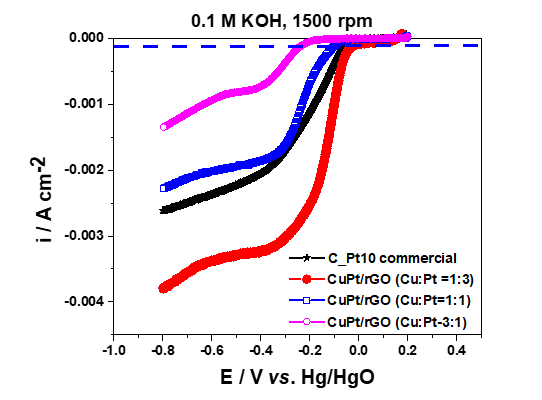
Electrocatalytic performance for the oxygen reduction reaction
Electrocatalytic performance for the oxygen reduction reaction (ORR), shown by comparative cathodic voltammograms recorded at 1500 rpm and 10 mV/s in O2-saturated 0.1 M KOH. The horizontal dotted line at a current density of −0.1 mA cm−2 indicates the reaction onset potential for the analysed samples.
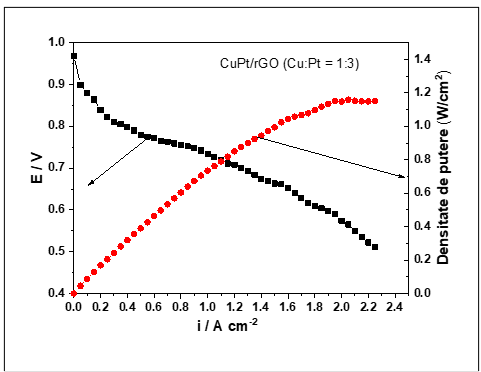
Performance of the CuPt/rGO catalyst in the PEM fuel-cell prototype
Performance of the CuPt/rGO catalyst (Cu:Pt = 1:3) in the PEM fuel-cell prototype: voltage–current-density curve and power-density–current-density curve.

NRRP. Funded by the European Union – NextGenerationEU

https://mfe.gov.ro/pnrr/; https://www.facebook.com/PNRROficial

The content of this material does not necessarily represent the official position of the European Union or the Government of Romania.